

Description
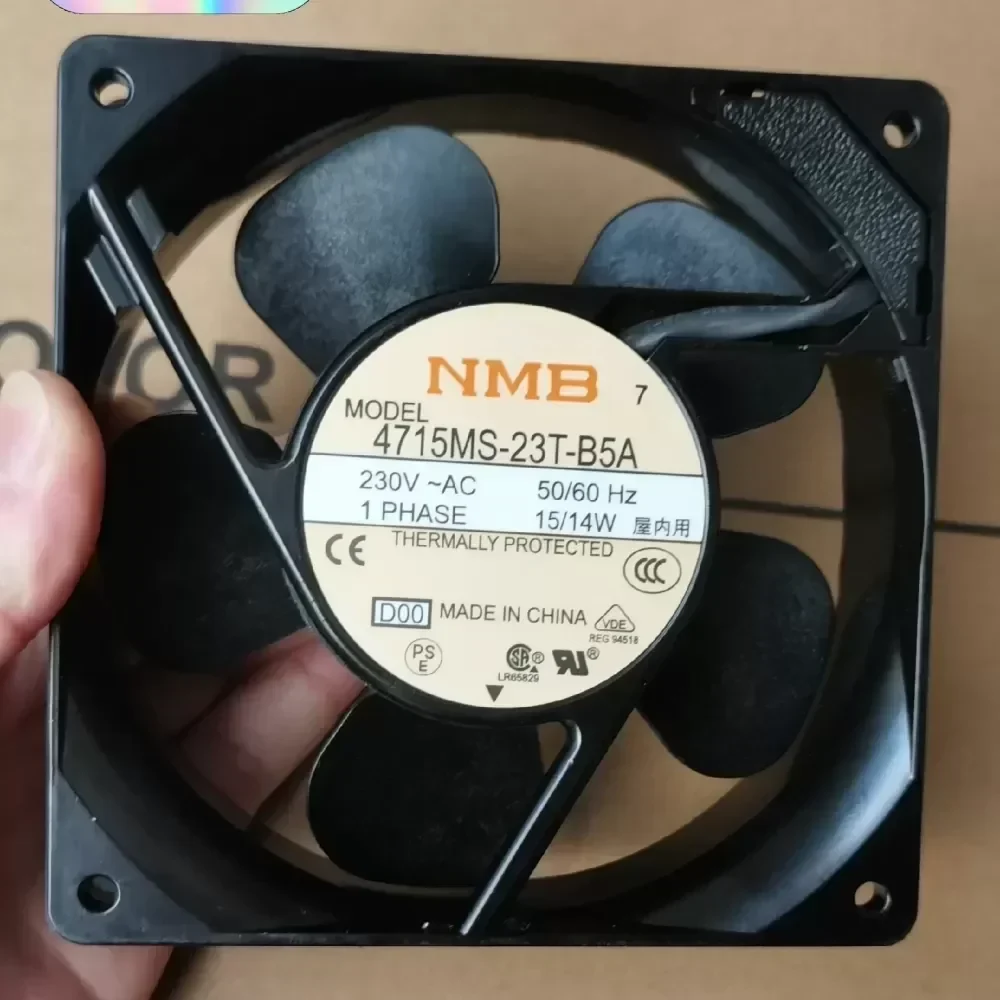
The NMB 4715MS-23T-B5A is an industrial-grade AC axial cooling fan engineered for high-reliability thermal management in critical infrastructure. Manufactured by MinebeaMitsumi, this 120x120x38mm exhaust fan delivers exceptional airflow and static pressure, making it an essential component for continuous-duty applications. Utilizing a robust shaded pole induction motor and precision dual ball bearings, it ensures extended operational longevity even in demanding thermal environments.
Technical Specifications
Manufacturer: NMB Technologies (MinebeaMitsumi)
Model Number: 4715MS-23T-B5A
Frame Size: 119mm x 119mm x 38mm (12038 form factor)
Operating Voltage: 230V AC
Frequency: 50/60 Hz
Airflow (50/60Hz): 2.50 m³/min / 2.90 m³/min
Static Pressure: 65 Pa / 85 Pa
Rotational Speed: 2600 RPM / 2900 RPM
Acoustic Noise: 37 dB(A) / 41 dB(A)
Power Consumption: 15.0W / 14.0W
Current Rating: 0.12A / 0.10A
Bearing System: Precision Dual Ball Bearing
Housing Material: Aluminum
Impeller Material: Glass Fiber Reinforced Plastic (UL94V-0)
Termination: Faston Terminals
Operating Temperature: -10°C to +70°C
Weight: 550g
Industrial Application and Technical Compatibility
This cooling fan is specifically designed for integration into Uninterruptible Power Supply (UPS) systems, server chassis, and industrial control cabinets. In high-density power conversion environments, the 4715MS-23T-B5A actively mitigates thermal throttling by rapidly exhausting localized heat pockets. Its aluminum die-cast frame provides superior structural rigidity against mechanical vibration, while the dual ball bearing architecture guarantees Technical Compatibility with systems requiring 24/7 uninterrupted operation.
Procurement and Lifecycle Value
Sourced through Original Engineering channels, this component guarantees exact form, fit, and function for drop-in replacement in existing NMB thermal arrays. We maintain optimized inventory protocols to ensure minimal Lead Time for critical maintenance operations, safeguarding your facility against costly thermal-induced downtime.
Reviews
There are no reviews yet.